
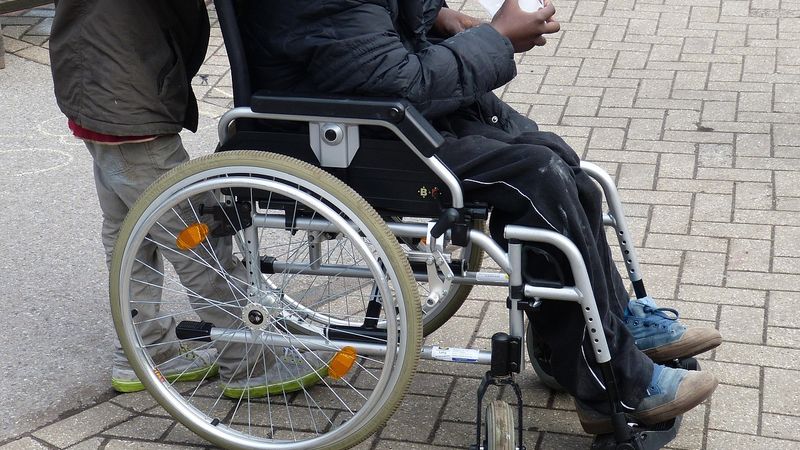
Jakarta, Kartunet.com – Law No. 4 of 1997 concerning Persons with Disabilities is considered no longer in line with current societal developments. The National Commission on Human Rights (Komnas HAM) along with disability rights activists have drafted a Bill on persons with disabilities, which is expected to be more oriented towards equal human rights for persons with disabilities. Here are the reasons why Law No. 4 of 1997 needs to be revised, and the advantages of the proposed Disability Bill.
The first and most fundamental aspect to be revised is the use of terminology. In the draft law, the term 'disability' is adopted, replacing the word 'cacat' (disabled/defective). The term 'disability' is adopted from the UN Convention on the Rights of Persons with Disabilities (UN CRPD), which states that disability results from the interaction with environments that do not support accessibility for them. Therefore, this term positions persons with disabilities as subjects, not merely 'defective' objects.
Secondly, the Disability Bill also includes regulations on habilitation. Habilitation refers to the ability to achieve independence, self-care, and work potential for individuals who have had disabilities since birth. In contrast, Law No. 4 of 1997 only contains rehabilitation regulations oriented towards welfare. With regulations on habilitation, there are provisions for how persons with disabilities can be empowered and contribute to the general public.
The principles have also undergone changes. While Law No. 4 of 1997 was based on improving social welfare, the Disability Bill places greater emphasis on the fulfillment and protection of rights. Persons with disabilities are positioned as free individuals with dignity and worth that must be respected. The fulfillment of these rights must also be based on independence, non-discrimination, participation, and equality as complete human beings. It is clear that the Bill aims for persons with disabilities to no longer be positioned merely as objects for welfare provision.
The Bill also prominently outlines the government's obligation to fulfill and protect various fundamental rights of persons with disabilities. These include the right to life, the right to decent education, the right to health services, the right to work and employment according to their wishes, the right to privacy, the right to family and procreation, the right to accessibility, the right to access information, and others. In this regard, the government is obliged to ensure that persons with disabilities obtain all their rights on the principle of equality.
The regulation concerning the obligation of businesses to employ persons with disabilities, a minimum of 1 percent of the total number of employees, has also been increased. In the Disability Bill, this number is expanded to 2 percent. Furthermore, the imposition of sanctions for those who do not comply with these regulations is stricter. Following administrative sanctions, there is a maximum criminal penalty of 5 years imprisonment and a fine of 1 billion rupiah.
The final point, which is a breakthrough in the Disability Bill, is the state's obligation to establish a National Commission for Persons with Disabilities. This Commission aims to ensure the realization of respect, protection, and fulfillment of the human rights and fundamental freedoms of persons with disabilities as stipulated in laws and other regulations concerning the rights of persons with disabilities. This institution is also tasked with ensuring the fulfillment of the protection of the rights of persons with disabilities by the government and increasing public awareness of persons with disabilities in various aspects of life.
In conclusion, the Disability Bill is expected to refine the previous law and better appreciate the existence of persons with disabilities as human beings. Hopefully, the House of Representatives will soon discuss and pass this Bill, which is the hope of all persons with disabilities in Indonesia.(DPM)